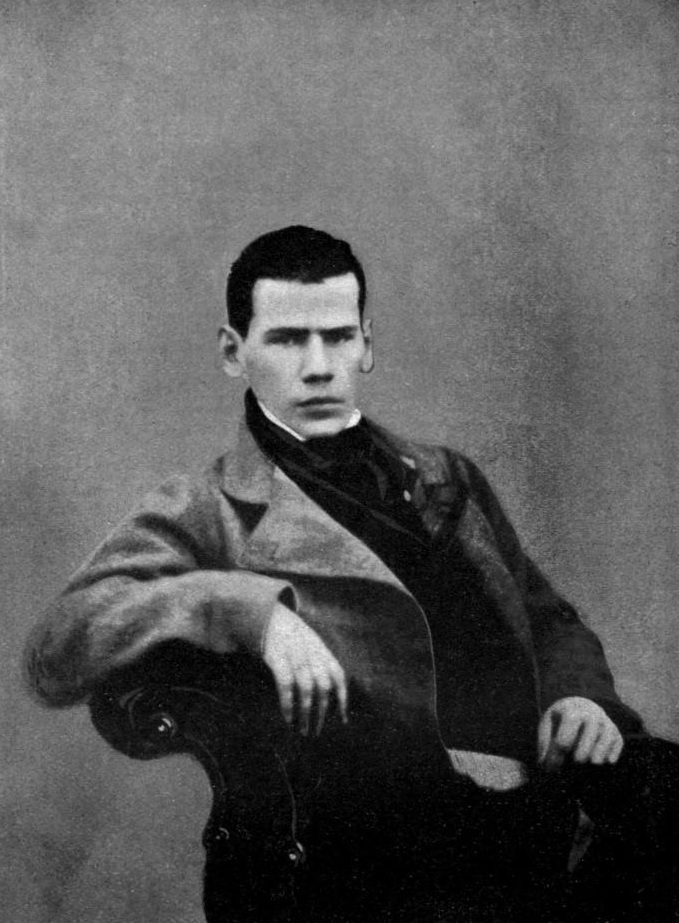
(September 9, 1828 – November 20, 1910), was a Russian writer of realist fiction and philosophical essays. His works War and Peace and Anna Karenina represent, in their scope, breadth and vivid depiction of 19th-century Russian life and attitudes, a peak of realist fiction.
Tolstoy's further talents as essayist, dramatist, and educational reformer made him the most influential member of the aristocratic Tolstoy family. His literal interpretation of the ethical teachings of Jesus, centering on the Sermon on the Mount, caused him in later life to become a fervent Christian anarchist and anarcho-pacifist. His ideas on nonviolent resistance, expressed in such works as The Kingdom of God Is Within You, were to have a profound impact on such pivotal twentieth-century figures as Mohandas Gandhi and Martin Luther King, Jr. Many consider Tolstoy to have been one of the world's greatest novelists
Tolstoy was born in
Yasnaya Polyana, the family estate in the
Tula region of Russia. The
Tolstoys were a well-known family of old Russian nobility. He was the fourth of five children of Count
Nikolai Ilyich Tolstoy, a veteran of the
1812 French invasion of Russia, and Countess Mariya Tolstaya (Volkonskaya). Tolstoy's parents died when he was young, so he and his siblings were brought up by relatives. In 1844, he began studying law and oriental languages at
Kazan University. His teachers described him as "both unable and unwilling to learn." Tolstoy left university in the middle of his studies, returned to Yasnaya Polyana and then spent much of his time in Moscow and
Saint Petersburg. In 1851, after running up heavy gambling debts, he went with his older brother to the
Caucasus and joined the
army. It was about this time that he started writing.
His conversion from a dissolute and privileged society author to the non-violent and spiritual anarchist of his latter days was brought about by his experience in the army as well as two trips around Europe in 1857 and 1860–61. Others who followed the same path were
Alexander Herzen,
Mikhail Bakunin, and
Peter Kropotkin. During his 1857 visit, Tolstoy witnessed a public execution in Paris, a traumatic experience that would mark the rest of his life. Writing in a letter to his friend V. P. Botkin: "The truth is that the State is a conspiracy designed not only to exploit, but above all to corrupt its citizens ... Henceforth, I shall never serve any government anywhere."
His European trip in 1860–61 shaped both his political and literary transformation when he met
Victor Hugo, whose literary talents Tolstoy praised after reading Hugo's newly finished
Les Miserables. A comparison of Hugo's novel and Tolstoy's
War and Peace shows the influence of the evocation of its battle scenes. Tolstoy's political philosophy was also influenced by a March 1861 visit to French anarchist
Pierre-Joseph Proudhon, then living in exile under an assumed name in Brussels. Apart from reviewing Proudhon's forthcoming publication,
La Guerre et la Paix (
War and Peace in French), whose title Tolstoy would borrow for his masterpiece, the two men discussed education, as Tolstoy wrote in his educational notebooks: "If I recount this conversation with Proudhon, it is to show that, in my personal experience, he was the only man who understood the significance of education and of the printing press in our time."
Fired by enthusiasm, Tolstoy returned to Yasnaya Polyana and founded thirteen schools for his serfs' children, based on the principles Tolstoy described in his 1862 essay "The School at Yasnaya Polyana".
[ Tolstoy's educational experiments were short-lived due to harassment by the
Tsarist secret police. However, as a direct forerunner to
A. S. Neill's
Summerhill School, the school at Yasnaya Polyana can justifiably be claimed to be the first example of a coherent theory of democratic education.
.

Tolstoy is one of the giants of Russian literature. His most famous works include the novels
War and Peace and
Anna Karenina and novellas such as
Hadji Murad and
The Death of Ivan Ilyich. His contemporaries paid him lofty tributes.
Dostoevsky thought him the greatest of all living novelists.
Flaubert, on reading a translation of
War and Peace, exclaimed, "What an artist and what a psychologist!"
Chekhov, who often visited Tolstoy at his country estate, wrote, "When literature possesses a Tolstoy, it is easy and pleasant to be a writer; even when you know you have achieved nothing yourself and are still achieving nothing, this is not as terrible as it might otherwise be, because Tolstoy achieves for everyone. What he does serves to justify all the hopes and aspirations invested in literature."
Later critics and novelists continue to bear testament to Tolstoy's art.
Virginia Woolf declared him the greatest of all novelists.
James Joyce noted that, "He is never dull, never stupid, never tired, never pedantic, never theatrical!".
Thomas Mann wrote of Tolstoy's seemingly guileless artistry: "Seldom did art work so much like nature". Such sentiments were shared by the likes of
Proust,
Faulkner and
Nabokov. The latter heaped superlatives upon
The Death of Ivan Ilyich and
Anna Karenina; he questioned, however, the reputation of
War and Peace, and sharply criticized
Resurrection and
The Kreutzer Sonata.
Tolstoy's earliest works, the autobiographical novels
Childhood,
Boyhood, and
Youth (1852–1856), tell of a rich landowner's son and his slow realization of the chasm between himself and his peasants. Though he later rejected them as sentimental, a great deal of Tolstoy's own life is revealed. They retain their relevance as accounts of the universal story of growing up.
Tolstoy served as a
second lieutenant in an artillery regiment during the
Crimean War, recounted in his
Sevastapol Sketches. His experiences in battle helped stir his subsequent
pacifism and gave him material for realistic depiction of the horrors of war in his later work.
His fiction consistently attempts to convey realistically the Russian society in which he lived.
The Cossacks (1863) describes the
Cossack life and people through a story of a Russian aristocrat in love with a Cossack girl.
Anna Karenina (1877) tells parallel stories of an adulterous woman trapped by the conventions and falsities of society and of a philosophical landowner (much like Tolstoy), who works alongside the peasants in the fields and seeks to reform their lives. Tolstoy not only drew from his own life experiences but also created characters in his own image, such as Pierre Bezukhov and Prince Andrei in
War and Peace, Levin in
Anna Karenina and to some extent, Prince Nekhlyudov in
Resurrection.
Tolstoy is one of the giants of Russian literature. His most famous works include the novels
War and Peace and
Anna Karenina and novellas such as
Hadji Murad and
The Death of Ivan Ilyich. His contemporaries paid him lofty tributes.
Dostoevsky thought him the greatest of all living novelists.
Flaubert, on reading a translation of
War and Peace, exclaimed, "What an artist and what a psychologist!"
Chekhov, who often visited Tolstoy at his country estate, wrote, "When literature possesses a Tolstoy, it is easy and pleasant to be a writer; even when you know you have achieved nothing yourself and are still achieving nothing, this is not as terrible as it might otherwise be, because Tolstoy achieves for everyone. What he does serves to justify all the hopes and aspirations invested in literature."
Later critics and novelists continue to bear testament to Tolstoy's art.
Virginia Woolf declared him the greatest of all novelists.
James Joyce noted that, "He is never dull, never stupid, never tired, never pedantic, never theatrical!".
Thomas Mann wrote of Tolstoy's seemingly guileless artistry: "Seldom did art work so much like nature". Such sentiments were shared by the likes of
Proust,
Faulkner and
Nabokov. The latter heaped superlatives upon
The Death of Ivan Ilyich and
Anna Karenina; he questioned, however, the reputation of
War and Peace, and sharply criticized
Resurrection and
The Kreutzer Sonata.
Tolstoy's earliest works, the autobiographical novels
Childhood,
Boyhood, and
Youth (1852–1856), tell of a rich landowner's son and his slow realization of the chasm between himself and his peasants. Though he later rejected them as sentimental, a great deal of Tolstoy's own life is revealed. They retain their relevance as accounts of the universal story of growing up.
Tolstoy served as a
second lieutenant in an artillery regiment during the
Crimean War, recounted in his
Sevastapol Sketches. His experiences in battle helped stir his subsequent
pacifism and gave him material for realistic depiction of the horrors of war in his later work.
His fiction consistently attempts to convey realistically the Russian society in which he lived.
The Cossacks (1863) describes the
Cossack life and people through a story of a Russian aristocrat in love with a Cossack girl.
Anna Karenina (1877) tells parallel stories of an adulterous woman trapped by the conventions and falsities of society and of a philosophical landowner (much like Tolstoy), who works alongside the peasants in the fields and seeks to reform their lives. Tolstoy not only drew from his own life experiences but also created characters in his own image, such as Pierre Bezukhov and Prince Andrei in
War and Peace, Levin in
Anna Karenina and to some extent, Prince Nekhlyudov in
Resurrection.
After
Anna Karenina, Tolstoy concentrated on Christian themes, and his later novels such as
The Death of Ivan Ilyich (1886) and
What Is to Be Done? develop a radical
anarcho-
pacifist Christian philosophy which led to his
excommunication from the
Russian Orthodox Church in 1901. For all the praise showered on
Anna Karenina and
War and Peace, Tolstoy rejected the two works later in his life as something not as true of reality. Such an argument is supported in
The Death of Ivan Ilyich, whose main character continually battles with his family and servants, demanding honesty above the water and food needed to sustain him.