jueves, 14 de abril de 2011

leo tolstoy

 (September 9, 1828 – November 20, 1910), was a Russian writer of realist fiction and philosophical essays. His works War and Peace and Anna Karenina represent, in their scope, breadth and vivid depiction of 19th-century Russian life and attitudes, a peak of realist fiction.
Tolstoy's further talents as essayist, dramatist, and educational reformer made him the most influential member of the aristocratic Tolstoy family. His literal interpretation of the ethical teachings of Jesus, centering on the Sermon on the Mount, caused him in later life to become a fervent Christian anarchist and anarcho-pacifist. His ideas on nonviolent resistance, expressed in such works as The Kingdom of God Is Within You, were to have a profound impact on such pivotal twentieth-century figures as Mohandas Gandhi and Martin Luther King, Jr. Many consider Tolstoy to have been one of the world's greatest novelists
Tolstoy was born in Yasnaya Polyana, the family estate in the Tula region of Russia. The Tolstoys were a well-known family of old Russian nobility. He was the fourth of five children of Count Nikolai Ilyich Tolstoy, a veteran of the 1812 French invasion of Russia, and Countess Mariya Tolstaya (Volkonskaya). Tolstoy's parents died when he was young, so he and his siblings were brought up by relatives. In 1844, he began studying law and oriental languages at Kazan University. His teachers described him as "both unable and unwilling to learn." Tolstoy left university in the middle of his studies, returned to Yasnaya Polyana and then spent much of his time in Moscow and Saint Petersburg. In 1851, after running up heavy gambling debts, he went with his older brother to the Caucasus and joined the army. It was about this time that he started writing.
His conversion from a dissolute and privileged society author to the non-violent and spiritual anarchist of his latter days was brought about by his experience in the army as well as two trips around Europe in 1857 and 1860–61. Others who followed the same path were Alexander Herzen, Mikhail Bakunin, and Peter Kropotkin. During his 1857 visit, Tolstoy witnessed a public execution in Paris, a traumatic experience that would mark the rest of his life. Writing in a letter to his friend V. P. Botkin: "The truth is that the State is a conspiracy designed not only to exploit, but above all to corrupt its citizens ... Henceforth, I shall never serve any government anywhere."
His European trip in 1860–61 shaped both his political and literary transformation when he met Victor Hugo, whose literary talents Tolstoy praised after reading Hugo's newly finished Les Miserables. A comparison of Hugo's novel and Tolstoy's War and Peace shows the influence of the evocation of its battle scenes. Tolstoy's political philosophy was also influenced by a March 1861 visit to French anarchist Pierre-Joseph Proudhon, then living in exile under an assumed name in Brussels. Apart from reviewing Proudhon's forthcoming publication, La Guerre et la Paix (War and Peace in French), whose title Tolstoy would borrow for his masterpiece, the two men discussed education, as Tolstoy wrote in his educational notebooks: "If I recount this conversation with Proudhon, it is to show that, in my personal experience, he was the only man who understood the significance of education and of the printing press in our time."
Fired by enthusiasm, Tolstoy returned to Yasnaya Polyana and founded thirteen schools for his serfs' children, based on the principles Tolstoy described in his 1862 essay "The School at Yasnaya Polyana".[ Tolstoy's educational experiments were short-lived due to harassment by the Tsarist secret police. However, as a direct forerunner to A. S. Neill's Summerhill School, the school at Yasnaya Polyana can justifiably be claimed to be the first example of a coherent theory of democratic education.
.
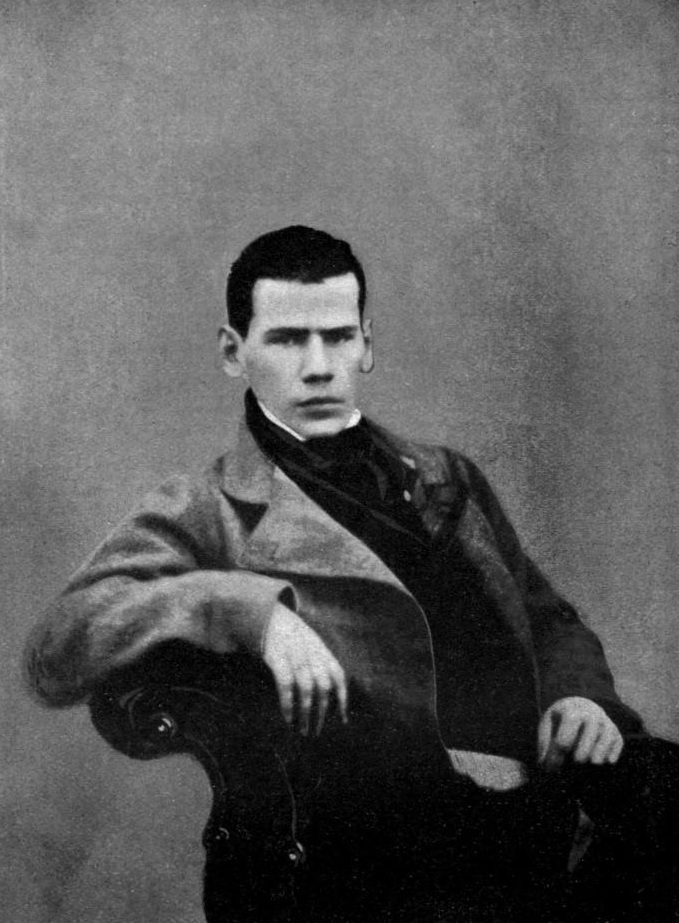


File:Lev Nikolayevich Tolstoy 1848.jpg


Tolstoy is one of the giants of Russian literature. His most famous works include the novels War and Peace and Anna Karenina and novellas such as Hadji Murad and The Death of Ivan Ilyich. His contemporaries paid him lofty tributes. Dostoevsky thought him the greatest of all living novelists. Flaubert, on reading a translation of War and Peace, exclaimed, "What an artist and what a psychologist!" Chekhov, who often visited Tolstoy at his country estate, wrote, "When literature possesses a Tolstoy, it is easy and pleasant to be a writer; even when you know you have achieved nothing yourself and are still achieving nothing, this is not as terrible as it might otherwise be, because Tolstoy achieves for everyone. What he does serves to justify all the hopes and aspirations invested in literature."
Later critics and novelists continue to bear testament to Tolstoy's art. Virginia Woolf declared him the greatest of all novelists. James Joyce noted that, "He is never dull, never stupid, never tired, never pedantic, never theatrical!". Thomas Mann wrote of Tolstoy's seemingly guileless artistry: "Seldom did art work so much like nature". Such sentiments were shared by the likes of Proust, Faulkner and Nabokov. The latter heaped superlatives upon The Death of Ivan Ilyich and Anna Karenina; he questioned, however, the reputation of War and Peace, and sharply criticized Resurrection and The Kreutzer Sonata.
Tolstoy's earliest works, the autobiographical novels Childhood, Boyhood, and Youth (1852–1856), tell of a rich landowner's son and his slow realization of the chasm between himself and his peasants. Though he later rejected them as sentimental, a great deal of Tolstoy's own life is revealed. They retain their relevance as accounts of the universal story of growing up.
Tolstoy served as a second lieutenant in an artillery regiment during the Crimean War, recounted in his Sevastapol Sketches. His experiences in battle helped stir his subsequent pacifism and gave him material for realistic depiction of the horrors of war in his later work.
His fiction consistently attempts to convey realistically the Russian society in which he lived.The Cossacks (1863) describes the Cossack life and people through a story of a Russian aristocrat in love with a Cossack girl. Anna Karenina (1877) tells parallel stories of an adulterous woman trapped by the conventions and falsities of society and of a philosophical landowner (much like Tolstoy), who works alongside the peasants in the fields and seeks to reform their lives. Tolstoy not only drew from his own life experiences but also created characters in his own image, such as Pierre Bezukhov and Prince Andrei in War and Peace, Levin in Anna Karenina and to some extent, Prince Nekhlyudov in Resurrection.


Tolstoy is one of the giants of Russian literature. His most famous works include the novels War and Peace and Anna Karenina and novellas such as Hadji Murad and The Death of Ivan Ilyich. His contemporaries paid him lofty tributes. Dostoevsky thought him the greatest of all living novelists. Flaubert, on reading a translation of War and Peace, exclaimed, "What an artist and what a psychologist!" Chekhov, who often visited Tolstoy at his country estate, wrote, "When literature possesses a Tolstoy, it is easy and pleasant to be a writer; even when you know you have achieved nothing yourself and are still achieving nothing, this is not as terrible as it might otherwise be, because Tolstoy achieves for everyone. What he does serves to justify all the hopes and aspirations invested in literature."
Later critics and novelists continue to bear testament to Tolstoy's art. Virginia Woolf declared him the greatest of all novelists. James Joyce noted that, "He is never dull, never stupid, never tired, never pedantic, never theatrical!". Thomas Mann wrote of Tolstoy's seemingly guileless artistry: "Seldom did art work so much like nature". Such sentiments were shared by the likes of Proust, Faulkner and Nabokov. The latter heaped superlatives upon The Death of Ivan Ilyich and Anna Karenina; he questioned, however, the reputation of War and Peace, and sharply criticized Resurrection and The Kreutzer Sonata.
Tolstoy's earliest works, the autobiographical novels Childhood, Boyhood, and Youth (1852–1856), tell of a rich landowner's son and his slow realization of the chasm between himself and his peasants. Though he later rejected them as sentimental, a great deal of Tolstoy's own life is revealed. They retain their relevance as accounts of the universal story of growing up.
Tolstoy served as a second lieutenant in an artillery regiment during the Crimean War, recounted in his Sevastapol Sketches. His experiences in battle helped stir his subsequent pacifism and gave him material for realistic depiction of the horrors of war in his later work.
His fiction consistently attempts to convey realistically the Russian society in which he lived.The Cossacks (1863) describes the Cossack life and people through a story of a Russian aristocrat in love with a Cossack girl. Anna Karenina (1877) tells parallel stories of an adulterous woman trapped by the conventions and falsities of society and of a philosophical landowner (much like Tolstoy), who works alongside the peasants in the fields and seeks to reform their lives. Tolstoy not only drew from his own life experiences but also created characters in his own image, such as Pierre Bezukhov and Prince Andrei in War and Peace, Levin in Anna Karenina and to some extent, Prince Nekhlyudov in Resurrection.


After Anna Karenina, Tolstoy concentrated on Christian themes, and his later novels such as The Death of Ivan Ilyich (1886) and What Is to Be Done? develop a radical anarcho-pacifist Christian philosophy which led to his excommunication from the Russian Orthodox Church in 1901. For all the praise showered on Anna Karenina and War and Peace, Tolstoy rejected the two works later in his life as something not as true of reality. Such an argument is supported in The Death of Ivan Ilyich, whose main character continually battles with his family and servants, demanding honesty above the water and food needed to sustain him.


File:Leo Tolstoy in uniform.jpg

jueves, 31 de marzo de 2011

Doctors Without Borders

Doctors Without Borders/Médecins Sans Frontières (MSF) is an international medical humanitarian organization created by doctors and journalists in France in 1971.
Today, MSF provides aid in nearly 60 countries to people whose survival is threatened by violence, neglect, or catastrophe, primarily due to armed conflict, epidemics, malnutrition, exclusion from health care, or natural disasters. MSF provides independent, impartial assistance to those most in need. MSF reserves the right to speak out to bring attention to neglected crises, to challenge inadequacies or abuse of the aid system, and to advocate for improved medical treatments and protocols.
In 1999, MSF received the Nobel Peace Pri
MSF operates independently of any political, military, or religious agendas. Medical teams conduct evaluations on the ground to determine a population's medical needs before opening programs. The key to MSF’s ability to act independently in response to a crisis is its independent funding. Ninety percent of MSF's overall funding (and 100 percent of MSF-USA's funding) comes from private sources, not governments. In 2008, MSF had 3.7 million individual donors and private funders worldwide.
MSF is neutral. The organization does not take sides in armed conflicts, provides care on the basis of need alone, and pushes for increased independent access to victims of conflict as required under international humanitarian law.

Bearing Witness & Speaking Out

MSF medical teams often witness violence, atrocities, and neglect in the course of their work, largely in regions that receive scant international attention. At times, MSF may speak out publicly in an effort to bring a forgotten crisis to public attention, to alert the public to abuses occurring beyond the headlines, to criticize the inadequacies of the aid system, or to challenge the diversion of humanitarian aid for political interests.
In 1985, MSF spoke out against the Ethiopian government's forced displacement of hundreds of thousands of its population; took the unprecedented step of calling for an international military response to the 1994 Rwandan genocide; condemned the Serbian massacre of civilians at Srebrenica in 1995; denounced the Russian bombardment of the Chechen capital, Grozny in 1999; and called for international attention to the crisis in Darfur in 2004 and 2005 at the United Nations Security Council.
In 2007, MSF called for international attention to the increased targeting of civilians in conflict in the Democratic Republic of Congo, Central African Republic, Chad, and Somalia; advocated for the widespread adoption of new protocols for the treatment of malnutrition to include the use of ready-to-use foods; challenged pharmaceutical company Novartis's court case opposing the production of generic medicines in India, which produces an estimated 80 percent of the developing world's medicines; and spoke out against the plan of the governments of Thailand and Laos threatened to forcibly return nearly 8,000 Hmong refugees to Laos.
MSF medical teams on the ground are in constant dialogue with local authorities, warring parties, and other aid agencies in an attempt to ensure the best possible medical care for patients and their communities and to reinforce the organization's operational independence.


Quality Medical Care

Chad 2007
© Anna-Karin Moden/MSF
MSF rejects the idea that poor countries deserve third-rate medical care and strives to provide high-quality care to patients and to improve the organization's practices. Through the Campaign for Access to Essential Medicines and, in recent years, in partnership with the Drugs for Neglected Diseases initiative, this work has helped lower the price of HIV/AIDS treatment and has stimulated research and development for medicines to treat malaria and neglected diseases like sleeping sickness and kala azar.

International Structure

MSF is an international movement made up of 19 associative organizations: Australia, Austria, Belgium, Canada, Denmark, France, Germany, Greece, Holland, Hong Kong, Italy, Japan, Luxembourg, Norway, Spain, Sweden, Switzerland, United Kingdom, and the United States.
Each association is responsible to a Board of Directors elected by its members (MSF's current and former field staff members) during an annual general assembly. Thanks to this large network, MSF has considerable financial, human, and logistical resources.
MSF-USA was founded in 1990 in New York City to raise funds, create awareness, recruit field staff, and advocate with the United Nations and US government on humanitarian concerns.
In 2007, MSF-USA raised $152.1 million, representing 20 percent of the MSF network's private funding. It sent 200 aid workers to work overseas, liaised with a wide range of US media, organized high-level meetings with UN and US government officials, and arranged regular speaking events and activities across the US.

my heroe

In my opinion i have to say than my granfather (part of my father) is my greates heroe of my life, becouse he is brave, smart and cool wiht her family, then in the other hand, i have to say than i are more proud of him becouse he served in the u.s army, unfortunally goes to the vietnam war, thanks god he return  safey to home, he born in july 13, 1943 in guatemala city, coming for a humble family he study hard to have a best oportunity of work, in  1949 he goes to the united states,  in 1961 he goes to the the college, after gradute , unfoprtunally the troops of the u.s.a goes to help the people of vietnam, then he can still study in the university, the army recruit him, then in 1965 was the  first time than he enter in action, since 1965 to 1969 he was in many places in vietnam like khe shan and cambodia,then when the war was over he return to america and study in the university of ole miss and her goal of graduate was complete, for that reason i admired him, for been a u.s. heroe, and i hope some day been like him

jueves, 24 de marzo de 2011

nursing home

what is the nursing home ??? :

is a place of residence for people who require constant nursing care and have significant deficiencies with activities of daily living. Residents include the elderly and younger adults with physical or mental disabilities. Residents in a skilled nursing facility may also receive physical, occupational, and other rehabilitative therapies following an accident or illness. Residents may have certain legal rights depending on the location of the facility.

Services provided in nursing homes include services of nurses, nursing aides and assistants; physical, occupational and speech therapists; social workers and recreational assistants; and room and board. Most care in nursing facilities is provided by certified nursing assistants, not by skilled personnel. In 2004, there were, on average, 40 certified nursing assistants per 100 resident beds. The number of registered nurses and licensed practical nurses were significantly lower at 7 per 100 resident beds and 13 per 100 resident beds, respectively.


Nursing homes that participate in the Medicare and Medicaid programs are subject to federal requirements regarding staffing and quality of care for residents. In 2004, 98.5% of the 16,100 nursing facilities nationwide were certified to participate in Medicare, Medicaid, or both.


HOW WE CAN HELP AN OLD MAN ???? :

we can help them go and cheer up her moral, visit them, talk whit them help in everything than they needed, ask them how are them ect., becouse them have more experience than us and we must respect them , dosen`t matter how old and forgetfull they are , we have to take care them, becouse they take care us when we was a baby :D


 ::

jueves, 10 de marzo de 2011

techniques and tools for soap carving

Pure Fun: Ivory Projects: Soap Carving Instructions and Tips


Any family member who is old enough to work with a carving tool can enjoy  make the carving soap. The shape and texture of Ivory Bar Soap make it ideal for creating fun, memorable soap sculptures, from the simple to the extraordinary. Here are a few suggestions to help make your soap sculpture its best.
What You’ll Need to Begin
Soap carving can be simple and inexpensive. You’ll need:
• A large bar of Ivory soap – Ivory's shape and texture are ideal for carving
• A paring knife
• 1-2 orangewood sticks used for manicures
• Pencil and paper for sketching
• Optional – Large tray to hold soap chips from carving Unwrap the soap and let it dry for a day. Scrape off the lettering and any raised edges before beginning.
1. Developing Your Design
Begin with a simple design. Start with solid, basic shapes with simple cuts or extensions. Sketch your idea on paper first or try one of these sample patterns.
ivory soap bear carving  
Sample Patterns for Soap Carving Designs
These designs are ideal for beginners. Simply:
• Print this page and cut out the design you want to use.
• Place the design on your prepared bar of Ivory soap and trace it onto the soap using carbon paper or a sharp pencil.
• With a little practice you’ll soon be ready to create designs of your own!
   
2. From Design to Soap Carving
• If you have a clear mental picture of your idea or have carved before, you can begin by carving directly on the soap.
• Or, you can use the orangewood stick to outline a rough sketch on each surface before you carve.
• Beginners may want to sketch or use a pre-existing pattern on paper and trace it onto the soap.
carving instructions1
3. Begin with Rough Cuts
The actual carvings begin with rough cuts that remove the large parts of the soap not necessary for your design.
• Place the soap on the table or tray.
• If you are right-handed, hold the soap with your left hand and start cutting at the upper right-hard corner. (If left-handed, use the opposite hand.)
• Leave about 1/4" margin beyond your outlined sketch to allow for mistakes and more detailed work later.
• Cut clear through the bar, removing excess soap all the way around.
• ALWAYS CUT AWAY ONLY SMALL PIECES OR SLICES. Soap often breaks if cut in big chunks.
carving instructions2
4. Adding the Details
• After the first cuts, you may find it more comfortable to use the knife as if peeling a potato. Continue to stay 1/8" to 1/4" away from your sketch guidelines to allow for finer work later.
• As you work, keep turning the soap, always keeping the shape of the piece in mind. Step back from time to time to look at the entire piece.
• Watch your high points -- those that jut out farthest from the surface -- and your low points -- those farthest in.
• Carve gradually from the high points toward the deepest cuts. Your knife point is useful for this.
• Don't try to finish any one part in detail before another.
• When the piece is almost finished, smooth rough edges with the knife’s edge and mark in details like eyes or ears with the knife tip or an orangewood stick.
carving instructions3
5. Polishing
• Allow your sculpture to dry for a day or two.
• Then, rub it with a soft paper napkin, being careful not to break off corners or high points.
• Finish by rubbing it gently with finger tops or palm.


carving instructions4

jueves, 3 de marzo de 2011

ancient toys and games of mayas

One of the ways that the Mayan people competed against each other was by playing what has been called the Ball Game or chaaj. They used a rubber ball, about 20 inches in diameter, to play the Game, which was played on a stone "court" who measurements varied. (The largest one found so far measures 459 feet by 114 feet underground.) The court had walls that sloped inward, and hanging high on the walls were stone rings.
The goal of the game was to pass the ball around, without having it touch your hands, and then get the ball to pass through one of the rings. Since the rings were so high and players were not allowed to use their hands, it was extremely difficult to get the ball through a ring, becouse only need the legs and arms. In fact, when a player did manage to get a ball through a ring, that usually ended the game. The game ended when the ball touched the ground.
The Mayan Ball Game was a solemn experience, and with ritual importance. Religious leaders attended, as did most chieftains and other government leaders of her's tribe. Sacred songs were sung and played sometimes. Other religious activities took place as well.
The winners of the game were treated as heroes or masters of the game and given a great feast. The penalty for losing a game was unusually harsh: death (human sacrifice). The leader of the team who lost the game was the first to be killed. This fit in with the Mayan belief that human sacrifice was necessary for the continued success of the peoples' agriculture, trade, and overall health and to make happy the gods.
The game was like games and sports that people play today in a few ways:
  • The players were working as a team to beat another team of players
  • The goal was to get the ball through a hoop or a net
  • The goal was also NOT to touch the ball with one's hands, like soccer is today.
  • Huge structures were built just for playing any sport
  • The games attracted very large numbers of people to watch
  • Gambling on who would win was common this days


ANCIENT MAYA TOYS

The art has survived uninterrupted for centuries and is now gaining recognition all over the world. The Maya are also known for unique baskets, pottery and wood carvings of animals, figurines and toys of animals and gods representation.


jueves, 10 de febrero de 2011

the murder of jhon f. kennedy

introduction : this blog are for that fans than like resolve an un-resolved mysteries and like use there brains to try figure out how resolve the problem or like use the logic in some times.

John F. Kennedy, the thirty-fifth President of the United States, was assassinated at 12:30 p.m.on Friday, November 22, 1963, in Dealey Plaza, Dallas, Texas. Kennedy was gravely shot while riding with his wife Jacqueline in a Presidential motorcade.


The ten-month investigation of the Warren Commission of 1963–1964 concluded that the President was assassinated by Lee Harvey Oswald. Oswald was murdered by Jack Ruby before he could stand trial and said thinks against him. This conclusion was initially met with support among the American public; however, imvestigations conducted from 1966 to 2004 concluded approximately 80 percent of the American public have held beliefs contrary to these findings.

Contrary to the Warren Commission, the United States House Select Committee on Assassinations (HSCA) in 1979 concluded that President John F. Kennedy was probably assassinated as a result of a conspiracy or for other politic who don't win.The HSCA found both the original FBI investigation and the Warren Commission Report to be seriously asepted. While they try to agree with the Commission that Oswald fired all the shots which caused the wounds to Kennedy and Texas Governor John Connally, it stated that there were at least four shots fired and that there was a "high probability" that two or four shooters fired at the President. No shooters or groups involved in the conspiracy were identified by the committee, but the CIA, Soviet Union, organized crime and several other groups were said to be not involved, based on a trustly evidence. The assassination is still the subject of unknow debate and has make numerous conspiracy theories and alternative scenarios.


At 12:30 P.M. CST, as Kennedy's uncovered limousine entered Dealey Plaza and slowly approached Dealey Plaza, which included the Texas School Book Depository, Nellie Connally, then the First Lady of Texas, turned around to Kennedy, who was sitting behind her, and commented, "Mr. President, you can't say Dallas doesn't love you," which President Kennedy acknowledged.
When the Presidential limousine turned and passed the Depository and continued down Elm Street, shots were fired at Kennedy; a clear highly of witnesses recalled hearing three shots.[6] A minority of the witnesses did recognize the first gunshot shoot they heard as a weapon fire, but there was hardly any reaction from a majority in the crowd or riding in the motorcade itself to the first shot, with many later saying they heard what they first thought to be a firecracker or the exhaust backfire of a vehicle just after the president started waving.


Within one second of each other, President Kennedy, Texas Governor John Connally, and Mrs. Kennedy, all turned abruptly from looking to their left to looking to their right was looking for everywere, between Zapruder film frames 155 and 169. Connally, like the president a WWII military veteran (and unlike the president, a longtime hunter), testified he immediately recognized the sound of a high-powered rifle like the springfield rifle or a m1 garand, then he turned his head and torso rightward attempting to see President Kennedy behind him. Connally testified he could not see the president, so he then started to turn forward again, and was hit in his upper right back by a bullet, fired in a gunshot that Connally testified he did not hear the muzzle blast from. He then shouted, "Oh, no, no, no. My God. They're going to kill us all!"


Mrs. Connally testified that right after hearing a first loud, frightening noise that came from somewhere behind her and to her right, she immediately turned towards President Kennedy and saw him with his arms and elbows already raised high with his hands already close to his throat. She then heard another gunshot and John Connally started yelling. Mrs. Connally then turned away from President Kennedy towards her husband, then another gunshot sounded and she and the limousine's rear interior were now covered with fragments of brain, blood, and bone matter.